Advancing IT, Projects & Transformation in the Public Sector
IT consulting for federal authorities, cantons, municipalities and public-sector organisations – from strategy to implementation.
Transformation works when strategy, technology and people come together. That’s where we come in – pragmatic, independent and focused on getting things done.
Oliver Gisin Rovsing | Division Lead Public
Digital transformation in the public sector presents federal authorities, cantons, municipalities and public-sector organisations with complex challenges. Legacy IT landscapes, regulatory requirements, limited resources and new technologies such as cloud and artificial intelligence require clear strategies and consistent implementation.
We help public-sector organisations successfully shape their digital transformation – from IT strategy and application modernisation to project turnaround and secure AI platforms. Practical, vendor-independent and backed by extensive experience in the public sector.
Digitalisation is not a Technology Project, but a Leadership Responsibility
Expectations of modern public administration are rising. Citizens and businesses want digital services that are simple, secure and accessible regardless of location. At the same time, skills shortages, regulatory requirements and limited resources are increasing the pressure on federal authorities, cantons and municipalities.
Legacy IT landscapes, a lack of interoperability and technical debt make implementation more difficult. New requirements around cloud, artificial intelligence, cybersecurity and digital sovereignty add further complexity.
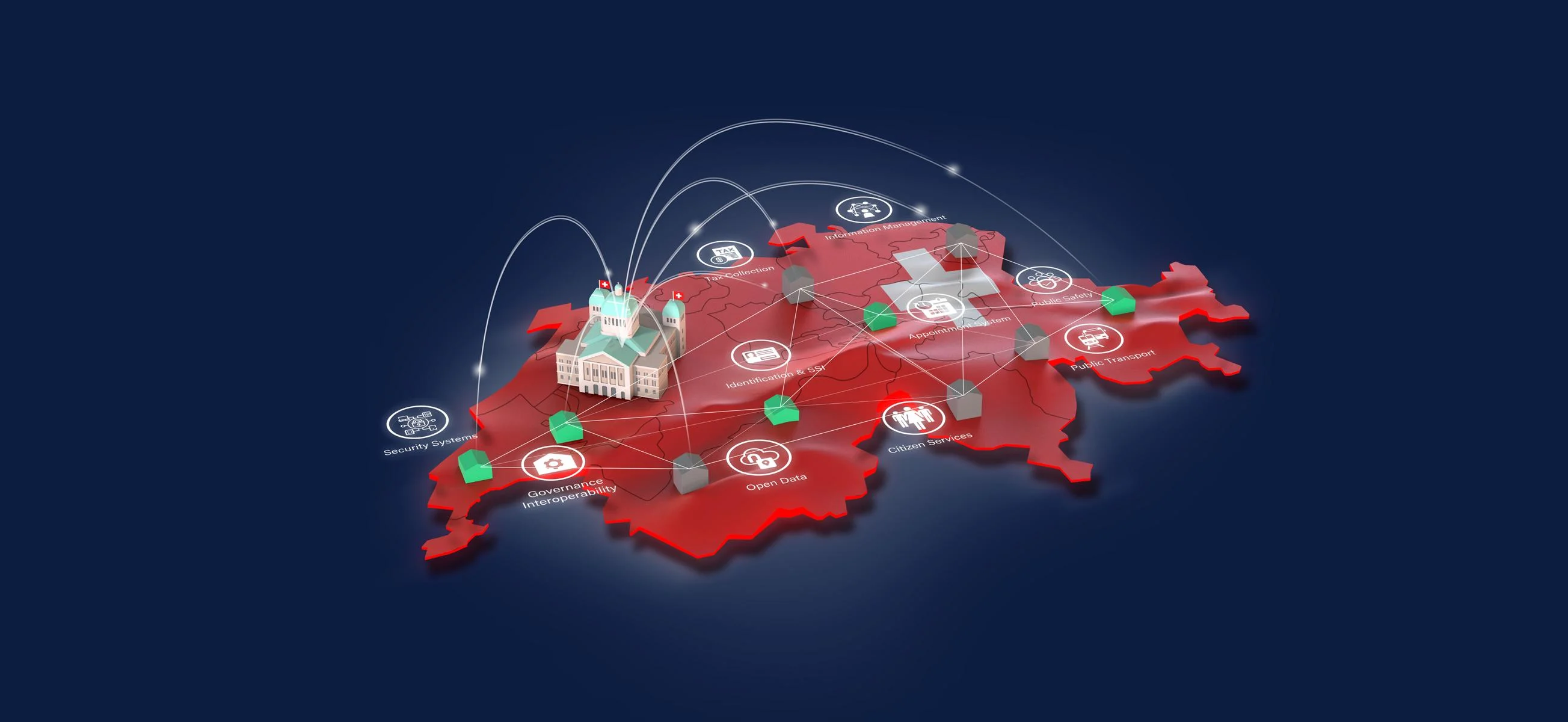
The “Digital Public Services Switzerland 2024–2027” strategy provides a common framework. We help public-sector organisations set priorities, reduce risks and implement sustainable solutions.
The biggest Challenges
Projects are delayed or at risk of failure
Costs increase, deadlines slip and trust among clients, steering committees and political decision-makers declines. Decisions become more difficult, risks increase and room for manoeuvre becomes increasingly limited.
The causes often lie in unclear objectives, weak governance, insufficient communication, inadequate coordination between business units, IT and external partners, or an ineffective project culture.
Legacy IT landscapes make change difficult
Application landscapes that have evolved over many years, with numerous interfaces, specialised solutions and vendor dependencies, make modernisation projects complex and costly.
Legacy systems make rapid data exchange between public authorities difficult. Disconnected processes and a lack of interoperability prevent end-to-end digital administrative processes. At the same time, organisations often lack a complete overview of the state of their IT landscape.
Technical debt continues to grow
Outdated technologies, unsupported systems and temporary solutions increase maintenance effort, inhibit innovation and generate significant long-term costs.
A structured maturity assessment provides a reliable basis for investment decisions and identifies which systems should be further developed, tolerated, migrated or replaced.
Business units and IT pursue different objectives
Requirements are interpreted differently, priorities change and projects lose focus. Without a common language and an agreed target vision, misunderstandings, additional effort and unnecessary risks arise.
Successful transformation requires clear responsibilities, transparent decision-making processes and close collaboration between administration, IT, leadership and political bodies.
Digitalisation does not deliver the expected benefits
New systems are introduced while existing processes remain largely unchanged. Disconnected workflows, duplicated effort and organisational barriers prevent digitalisation from delivering its full potential.
Digital transformation therefore requires profound change. Changing the working culture takes time and strong leadership. Public authorities need to build digital skills and foster a culture of lifelong learning.
Data, cloud and AI create new opportunities and risks
The use of data and cloud technologies can improve decision-making, accelerate processes and enable new services.
However, public-sector organisations process valuable and sensitive data and therefore face stringent requirements regarding data protection, information security and cybersecurity. Generative AI, RAG systems and automated workflows require clear governance, secure platforms and transparent responsibilities.
Cloud solutions can improve scalability, collaboration and the delivery of digital services, but must meet requirements for data protection, security and digital sovereignty.
Sustainability and infrastructure require investment
A stable IT infrastructure is a fundamental prerequisite for digital transformation. At the same time, modernisation and digitalisation require significant financial resources.
Energy-efficient data centres, sustainable procurement and green technologies are becoming increasingly important in view of climate targets. Digitalisation and sustainability should therefore be considered together.
This is where we start
We create transparency, develop realistic strategies and support organisations from initial analysis through to successful implementation.
We combine organisational, technological and strategic perspectives. Our recommendations are vendor-independent, practical and tailored to our clients’ specific circumstances.
Why Consulteer?
For many years, we have supported federal authorities, cantons, municipalities and public-sector organisations in complex digitalisation and transformation initiatives.
We understand the political decision-making processes, regulatory requirements and organisational characteristics of public administration. Our solutions are therefore designed to be not only technically sound, but also politically, financially and organisationally feasible.
We do not just deliver strategies or technical concepts. Ultimately, success depends on implementation.
That is why we support our clients from the initial assessment and target vision through architecture and roadmap development to implementation and integration into ongoing operations.
What sets us apart
We understand the public sector
Federal authorities, cantons, municipalities and public-sector organisations differ fundamentally from private-sector companies.
Political decision-making processes, public procurement law, federal structures, data protection and public accountability shape day-to-day project work. Our experts take these specific requirements into account from the outset.
We combine strategy and implementation
A good strategy provides direction. Consistent implementation creates impact.
We support our clients throughout the entire transformation process – from initial assessment and roadmap development to successful implementation within the organisation and its operations.
We create transparency
Sound decisions require a clear understanding of the current situation.
Whether project turnaround, IT strategy or application landscape, we make dependencies visible, assess risks and provide a reliable overview.
We take a long-term perspective
Our focus is not on the short-term optimisation of individual projects, but on sustainable long-term development.
We help organisations continuously improve their structures, processes, technologies and capabilities while making progress measurable.
The Consulteer Approach
1. Understand
2. Align
3. Implement
4. Embed
We analyse the current situation, objectives, constraints and risks.
This includes administrative processes, organisation, application landscape, data, capabilities and security requirements. Interviews, analyses and existing studies provide a solid foundation and a shared understanding.
Our Areas of Expertise
Holistic consulting for the public sector
Digitalisation is no longer limited to individual projects or systems. Successful organisations consider strategy, processes, data, technology, security and organisation as an interconnected whole.
Our six areas of expertise cover these topics and can be flexibly combined.
Project turnaround
We stabilise critical projects, create transparency and get initiatives back on track.
Typical questions include:
When is a project turnaround worthwhile?
What should be done when deadlines and budgets can no longer be met?
How can trust within the steering committee be restored?
How can a reliable assessment of the situation be established within a short period of time?
Application landscape and IT maturity
We create transparency across your system landscape, assess technical debt and develop a realistic modernisation strategy.
Using methods such as maturity assessments and the TIME model, we establish an objective basis for consolidation, migration and investment decisions.
Administrative processes and the GEVER ecosystem
We connect GEVER, specialist applications, email, digital signatures, identity management and archiving into an integrated digital ecosystem.
The value does not come from introducing a new system alone, but from integrated processes, clear roles and secure information flows.
Artificial intelligence
We support public-sector organisations in the secure and responsible adoption of AI – from strategy and governance to a production-ready platform.
Typical use cases include writing assistance, secure translations, report generation, RAG chatbots, voicebots and intelligent document classification.
IT strategy
We develop sustainable IT strategies that bring together political, organisational and technological requirements.
The result is a clear target vision with prioritised areas of action, defined responsibilities and a realistic roadmap.
Digital workplace, services and operations
We standardise workplace solutions, structure services and create the foundation for modern, cost-efficient and stable IT operations.
Hybrid working models and modern digital infrastructures improve the user experience and strengthen public-sector organisations in the competition for skilled professionals.
Digital Public Services for Citizens & Businesses
E-government enables citizens and businesses to access public services simply, securely and regardless of location. Secure e-ID systems and the Once-Only Principle provide an important foundation and reduce the need to submit the same information repeatedly to different public authorities.
Digital transformation is progressing at different speeds across the federal government, cantons, municipalities and other public institutions. The Federal Council, cantonal governments and public administrations must balance technological opportunities, regulatory requirements and the needs of the population.
We can support you in Areas such as …
a project is under political or operational pressure,
you want to develop or update your IT strategy,
your application landscape has grown over many years,
you want to systematically reduce technical debt,
you want to establish a secure AI platform,
GEVER is not delivering the expected benefits,
you want to create more integrated digital administrative processes,
you want to standardise your digital workplace and IT services,
or you need a reliable basis for decisions about the next stage of your digital transformation.
Your Project. Our Passion. We look forward to your inquiry.
FAQs on Digital Transformation in the Public Sector
How does Consulteer support digital transformation in the public sector?
Consulteer supports federal authorities, cantons, municipalities, cities and public-sector organisations in the digitalisation of their organisations, processes and IT landscapes.
Our services range from IT strategy, project turnaround and maturity assessments to the modernisation of application landscapes and GEVER ecosystems, as well as the introduction of secure cloud and AI solutions.
We support public-sector organisations not only with analysis, strategy and target vision development, but also with implementation, governance, project management, rollout and integration into ongoing operations.
Our consulting is vendor-independent, practical and tailored to the specific requirements of the public sector – including federal structures, data protection, cybersecurity, procurement processes and political decision-making.
Why do cantons, municipalities and public-sector organisations need an IT strategy today?
Digitalisation affects almost every area of public administration. Without a clear IT strategy, parallel initiatives, conflicting priorities and investments without long-term direction can quickly emerge.
A modern IT strategy brings together organisation, administrative processes, data, technology, security and governance. It creates a shared target vision and a reliable basis for decision-making for federal authorities, cantons, municipalities and public-sector organisations.
Skills shortages, rising expectations among citizens, and increasing demands regarding digital services and sustainability create additional pressure for action. Modernisation therefore requires investment in stable, energy-efficient infrastructure and resource-efficient technologies.
When should an IT strategy be reviewed?
An IT strategy should be reviewed when major digitalisation programmes are planned, organisational changes take place or new technologies such as cloud and artificial intelligence are introduced.
Reorganisations, new regulatory requirements or a significantly expanded application landscape may also require strategic realignment.
In Switzerland, the “Digital Public Services Switzerland 2024–2027” strategy, which entered into force on 1 January 2024, provides a common framework for the federal government, cantons, cities and municipalities.
How do you develop a sustainable IT strategy for a municipality or canton?
The process begins with a realistic assessment of the current situation, covering the organisation, administrative processes, applications, data, capabilities, security and existing services.
Based on this assessment, a shared target vision is developed. It defines how the administration, IT landscape and digital services should evolve over the coming years. Areas of action, priorities, responsibilities and an achievable roadmap are then defined.
Digital transformation is not simply a technology project. It requires cultural change, time, strong leadership and a culture of lifelong learning. Rigid hierarchies and lengthy decision-making processes can hinder the necessary adaptation of administrative processes.
What is a project turnaround and when is it necessary?
A project turnaround is a time-limited initiative designed to bring a critical project back to a stable, transparent and manageable state.
Typical warning signs include missed deadlines, budget overruns, unclear responsibilities, declining stakeholder confidence or reporting that no longer reflects the actual situation.
An initial assessment phase can provide a reliable picture of the situation within one to two weeks. Based on this assessment, a decision can be made on whether to stabilise, restart or systematically terminate the project.
What is an application landscape and why is modernisation important?
An application landscape comprises all specialist applications, platforms, interfaces and supporting systems within an organisation.
Legacy IT landscapes and systems often make rapid data exchange between public authorities difficult. They create media discontinuities, vendor dependencies, higher operating costs and technical debt.
A maturity assessment creates transparency about the current state of the IT landscape and provides an objective basis for modernisation, consolidation and investment decisions. Modern data platforms and cloud technologies can improve decision-making, provided that data protection, governance and cybersecurity requirements are met.
What is a GEVER ecosystem and what benefits does it offer?
A GEVER ecosystem connects records and process management, specialist applications, email, digital signatures, identity management and archiving into an integrated solution.
A GEVER system alone does not create end-to-end digital administration. The real value emerges when administrative processes, roles, data and connected systems work together.
An integrated GEVER ecosystem reduces media discontinuities, improves collaboration between public authorities and increases traceability. Interoperability is essential for the secure exchange of information between federal authorities, cantons and municipalities.
How can data, cloud and artificial intelligence be used securely in public administration?
Digital transformation in the public sector is increasingly data-driven. Data, cloud technologies and artificial intelligence can accelerate administrative processes, improve decision-making and enable new digital services.
Generative AI is increasingly being explored by public-sector organisations for use cases such as writing assistance, secure translation, report generation, RAG chatbots, voicebots and document classification.
Because public authorities process sensitive data, stringent requirements regarding data protection, information security, cybersecurity and digital sovereignty are essential. Data protection requirements can make agile processes more demanding, but they are a fundamental prerequisite for trustworthy digital public services.
How can data, cloud and artificial intelligence be used securely in public administration?
Technology alone does not transform public administration. Successful digitalisation requires new ways of working, digital skills, clear responsibilities and a culture of lifelong learning.
Changing the working culture takes time and strong leadership. Rigid hierarchies, unclear decision-making processes and insufficient collaboration between business units and IT can significantly slow progress.
Cultural change is therefore a key success factor in digital transformation.
What role do e-government, e-ID and digital public services play?
E-government refers to the digital delivery of national and municipal public services. The goal is to provide user-friendly, secure, accessible services that can be used regardless of time and location.
Secure electronic identities such as e-ID provide an important foundation for digital interactions between citizens, businesses and the state. The Once-Only Principle aims to prevent the same information from having to be submitted repeatedly to different public authorities.
Digital channels also make official information easier to access and can strengthen citizen participation in democratic processes. Analogue services should nevertheless be maintained alongside digital channels to ensure that public services remain accessible to all sections of society.
The public-law framework agreement on Digital Public Services Switzerland entered into force on 1 January 2022. Since then, Digital Public Services Switzerland (DPSS) has been operational and supports coordination between the federal government, cantons, cities and municipalities.